If you caught last week’s post on pre-transplant testing, consider this the second installment. Today, I’ll be diving into what goes into actually planning for a stem cell transplant, more specifically, the logistics and everything that you might want to consider before admission.
Since there’s a lot to cover, I’ll be breaking this post into sections to make it easier to follow.
Just like in the last post, I don’t have many relevant graphics or photos for most of these sections, so instead, I’ll be sharing a few snapshots from my life over the past couple of months. Hope you enjoy them.

Disclaimer: As always, just a reminder that I’m speaking from my own experience. The details I’ve had to consider are specific to my situation and my timeline. While I imagine many of these topics will apply to others as well, the things you need to consider may vary.
Work & Paid Leave
Starting off strong, let’s talk about the prolonged absence from work that most patients will need during this process. And by “most,” I really mean all. There’s no scenario where you can go through a transplant and just continue with your normal work schedule. You’ll need time.
Luckily, there are options. For some background on my situation, I work full-time as a program coordinator for an energy services company based in Connecticut. My role is fully remote, aside from the occasional team meet-up or company event.

After I was diagnosed in January, my first stop was a quick conversation with HR. It was basically a “here’s the deal” kind of talk where I laid out everything I knew at the time about my situation. Thankfully, they were very understanding and walked me through the steps I’d need to take to make sure everything was in order when the time came.
In my case, the steps were pretty straightforward: submit leave paperwork to HR, apply for FMLA through the company’s leave administrator, and file for paid leave through the state of Connecticut.
A slow death by paperwork basically. Just kidding. Honestly, none of these steps were all that bad. Some of the forms you’ll fill out yourself, while others will be completed by your care team. Once everything is submitted to the appropriate administrators, they can usually get a decision back to you within a few business days.
The main thing they ask is that you submit everything as early as possible in case there are any delays or issues. Ideally, your treatment will not begin before your leave is officially approved.

One positive I want to highlight is that if you’re going through the stem cell transplant process, you’re unlikely to face much of any pushback about your leave. No “Is this really necessary?” or “Do they really need that much time?” type questions. Most people understand just how serious this is, which makes applying for FMLA and paid leave a lot less stressful.
Those options will likely be your first stop, and they usually provide around twelve weeks of coverage within a calendar year. As you can imagine, that’s a huge relief. Knowing you have job protection and will still receive a portion of your paycheck (60 to 70 percent in my case) during treatment is definitely welcome news.
After those initial twelve weeks, you’ll most likely be eligible for some form of disability coverage as well. For most people, the expected return-to-work date, if all goes well, is around the six-month mark. I imagine this is because your immune system is still recovering, and your care team wants to minimize your exposure to illness as much as possible during those first critical months.

In my case, since I work remotely, I probably won’t need to be out of work for the full six months. As long as I’m feeling mentally and physically well and recovering steadily, I’m hoping to return before my FMLA and Connecticut Paid Leave coverage runs out at the end of the initial twelve weeks.
That being said, everything depends on how my recovery goes. Either way, if you are in a similar situation, just know that you have options, and given the nature of this treatment, those options are unlikely to be denied. At this point, I’ve been approved for both paid leave and FMLA job protection, so I’m as prepared as I can be on the work front for my upcoming admission.
Caregivers
Before diving into housing and other logistics, I want to highlight the importance of caregivers. During your treatment, you’ll need at least one dedicated person to help with day-to-day tasks. For the first couple of months, you’ll essentially be on some form of lockdown, so having someone to prepare meals, clean, grocery shop, and handle other essentials will be absolutely crucial.
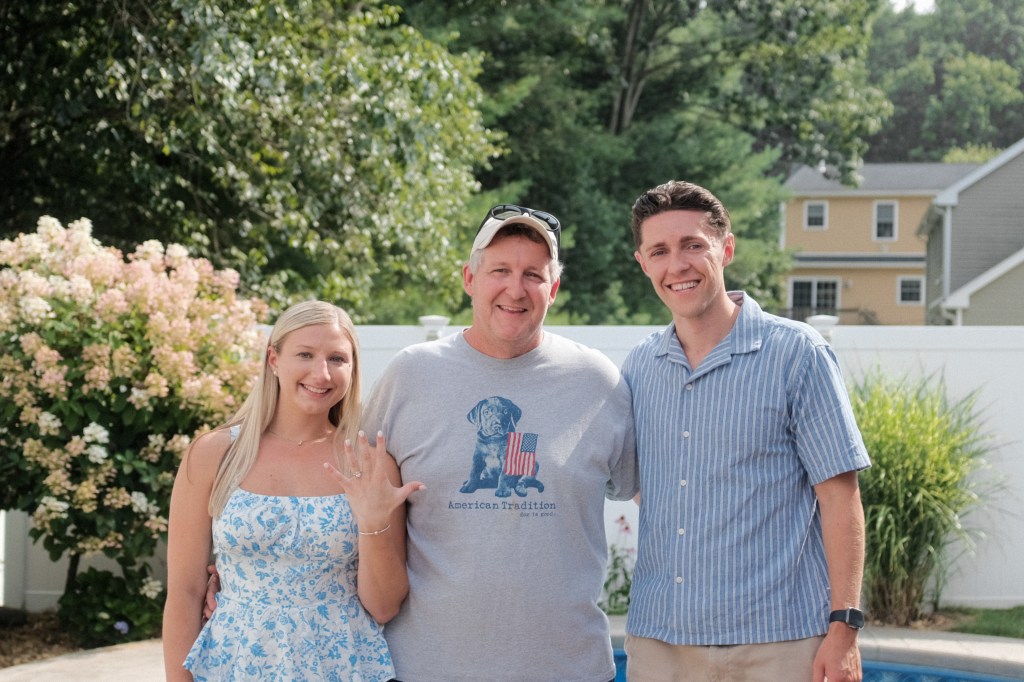
I’m lucky to have what I’d call the caregiving equivalent of the 2012-2013 Miami Heat. In other words, the dream team. That roster includes my mom, my dad, my older brother, and his fiancé.

In a recent pre-transplant webinar, I learned that although there’s a long list of caregiver duties, I should be able to manage some of them on my own. The list mainly serves as a framework to help caregivers understand the responsibilities they might have to take on during the recovery process.
I highly recommend taking a look if you are in a similar situation or will be playing the role of caregiver for someone else as they undergo treatment. I’ll also be including links to several caregiver resources below for anyone interested in exploring further.
Please also keep in mind that there are also leave options available for caregivers. For that, the best place to start is probably an honest conversation with your respective HR department, as they can usually walk you through the appropriate steps to take and what resources might be available.
Housing
As the patient, I know exactly where I’ll be for the first month, no coordination needed on my part for that. But once I’m discharged, the ball is more in my court.
Some treatment centers may require you to stay nearby for a while after the transplant, depending on how your hospital stay goes and how far you live from the center. I live about an hour and a half to two hours from Dana-Farber, and I was told that I should be able to return home shortly after my hospital discharge.

As much as I appreciated hearing that, my family and I decided to go with an alternative plan to make things easier for everyone and to have some peace of mind by staying closer for a while after I’m discharged.
As it stands, I plan to stay at the AstraZeneca Hope Lodge in Boston for about a month after my hospital discharge. We chose the Hope Lodge for several reasons, but one of the biggest advantages is that it’s free for patients and their caregivers who are going through active treatment.
I’ll likely write another post about my experience at the Hope Lodge after I’m discharged, but for now, I’m just grateful that places like this exist. They currently have over 30 locations across the United States and Puerto Rico and do incredible work providing safe, free lodging for people undergoing cancer treatment and cancer adjacent treatments. I’ll be sure to include a link to their website below in case you would like to learn more.

Another big upside of staying at the Hope Lodge is its location. Just about a mile from Dana-Farber. I’m hoping that kind of closeness will bring some peace of mind to both me and my family as I begin the recovery process.
During my month long stay there, each of my parents will do a roughly two-week rotation with me. While shorter stays could have been arranged, the team recommended longer stretches to help limit exposure. Because of that, two slightly longer rotations felt like the best balance for all of us.

After my discharge from the Hope Lodge, I’ll be moving in with my brother, his fiancée, and their dog Luna for another month or two. They live in Massachusetts, and are about an hour or so from the hospital. At that point my recovery should be more stable, and we’ll all have a clearer picture of what things actually look like, so being a bit further away likely won’t be an issue.

Eventually, I’ll return to my apartment in Connecticut, which I plan to hold onto throughout treatment. Hopefully, I’ll be home before the holiday season kicks off, and I can start settling back into my life little by little. I’ll still be on lockdown during that time, but the odds of me wanting to go out much in the dead of winter are pretty low, so honestly, the timing works out well.
So, that’s my housing plan. Depending on your recovery and the recommendations from your care team, yours may look a little different. Many treatment centers also have partnerships with nearby hotels that offer discounted rates for patients and their families, which can be helpful if free housing options aren’t available and you would like to stay close by. All of these options will likely be shared with you, but if not, they’re definitely worth asking about.

I’ll end this section with a piece of advice I got from one of the social workers at Dana-Farber: make sure your housing plan can work for a few different scenarios. In my case, the Hope Lodge stay can be extended or shortened if needed, but we purposely built in a buffer between my hospital discharge and staying further away with family, just in case things don’t go exactly as planned.
If boredom ends up being my biggest issue, great, that’s exactly what we’re hoping for. But if it’s not, then being close to the hospital like we will be will be a huge advantage. The main thing is to make sure your housing plan works for every outcome, not just the idealized one.
Apartment Prep
As I mentioned, I plan to hold onto my apartment throughout this process. That is possible in large part because of the paid leave I’ll be receiving. I moved in last summer and have really grown to love every square foot of this little place. I think having somewhere familiar to come home to after everything will go a long way in helping me mentally on the tougher days.
Since I plan on keeping it, I have been doing a good amount of prep work to make sure the space is as clean and organized as possible for when I return home. I fully admit that some of these decisions may have been a little over the top, but I’m happy with how things have come together and thought I’d share a few of the upgrades and improvements I’ve made to get the apartment recovery-ready.
First up, I bought an exercise bike. As a runner, I never had much time, energy, or interest in biking, but by necessity, that’s probably about to change. Since I’ll likely be getting back just as winter kicks in here in New England, I wanted a solid indoor option to start rebuilding my cardiovascular health.

I’ll link the exact model I went with down below. While I can’t say I’m excited to spend hours on it, it feels like the safest option. Definitely better than doing nothing, and probably better than braving the cold with a fragile immune system.
Next, I gave my apartment a bit of a fabric overhaul. Pretty much every piece of fabric that’s not clothing: towels, washcloths, dish towels, bedding, and so on, has been or will be replaced before I leave. I’ve already got everything ready, but I’m holding off on switching things out until just before I go, so everything will be fresh and clean when I come back.
Last but not least, I replaced a lot of my cookware. When I first moved out, I brought along quite a bit of hand-me-down stuff. Plates, pots, pans, utensils, you name it. They’ve served me well, but since they’ve been in the family for a long time, I started wondering how clean they really were. So, in doing my apartment prep, I decided it was also time for a kitchenware facelift.

All and all, after more money spent and more Amazon orders than I’d care to admit, my apartment looks a bit different than it did just a few weeks ago. That said, I don’t regret a single change. I want to feel safe here, and if there’s anything I can do ahead of time to make that a reality before I return, I figure I owe it to myself to get it done.
Like I said, some of the changes I made were probably overkill, but I’d at least recommend checking out a “preparing the home” list (I’ll link to one) to get a sense of what you might want to adjust in your own living space before returning from treatment.
Financial Planning
I’ll kick off this section by linking directly to a few financial resources available to stem cell transplant patients. One is from Dana-Farber, and the other is from the NMDP, which I mentioned in the previous post. They do a lot to support patients and caregivers and have an excellent page outlining financial assistance options, along with links to other helpful tools and programs.
As you can probably imagine, stem cell transplants are very expensive. If you ever want a laugh, or a minor heart attack, just Google it. That said, depending on your health insurance, you’ll likely be covered for a large portion of the cost.

I can’t guarantee that, of course, but from what I understand, stem cell transplants aren’t exactly routine procedures. If you’re having one, or even being considered for one, it likely means you’re dealing with a serious condition and there aren’t many (or any) alternative treatment options.
Much like getting approved for leave from work, there are very few insurance companies that would deny a claim like this on the grounds of it not being necessary. I mention that to hopefully ease any anxiety you may be feeling about the financial side of this treatment.
In my case, my health insurance has really stepped up to bat for me, and that’s allowed me to focus more on getting through the transplant rather than stressing about how it’s going to be paid for. I’ll be forever grateful for that, and I hope it’s a shared experience for others, too.
I’ll also mention that my health insurance has offered a number of transplant-related resources I can take advantage of if needed, both financial and mental health related. On the financial side, they have a travel and lodging reimbursement policy I could use if we end up needing to pay out of pocket for housing or travel to and from Boston at any point. Nice to have, just in case.
On the mental health side, I’m eligible for a few transplant specific counseling sessions if I need them at any point. Thankfully, I’m surrounded by plenty of options in that department which is definitely not a bad problem to have.
Moral of the story: Ask your health insurance provider if they offer any additional resources or financial aid for patients going through this process. If they do, great. If they don’t, that’s okay too. There are plenty of other resources out there designed for this exact scenario, and if you need to, I’d definitely recommend sitting down with your care team or care coordinator to go over what those options might be.
Communication
Setting up a communication plan will depend on how, or if, you decide to share what’s going on with the people in your life. Regardless of your approach, it’s probably a good idea to set up a loose communication strategy ahead of time so you can keep people updated without adding extra stress during treatment.
There will almost definitely be days when you just don’t feel like talking, or doing much of anything, really. That’s why it helps if the people who are in the loop have a general idea of what to expect in terms of updates. Setting those expectations early can save you from feeling overwhelmed later.
Personally, I’ve told my family and a few others, but I haven’t shared everything with my broader social network yet if that makes sense. While I’m sure the support would be wonderful, I’d rather focus on getting through this first without the added pressure of keeping my world updated.
This blog is a bit of an exception, since I want to share my story and hopefully provide value to others going through similar situations. Even so, I’ve only shared it with a few family members and a few select outlets where I think it can have the most direct impact. There will come a time when I share it more broadly, but for now, I’m happy with the way I’m handling things.

Essentially, plan out what will be best for your mental health and recovery when it comes to communicating, and make sure your caregivers have an understanding of your plan so they can assist in updating people or receive messages on your behalf so you can focus on what is most important.
Admission Details
Not that I’ve been keeping it a secret, but I realized last week that I haven’t actually shared the details of my admission yet. So, I wanted to make sure to cover that in this post.
As of now, my admission to Dana-Farber is scheduled for Friday, August 8th. The first day will involve having my two central lines placed, followed by getting settled into my room. Chemotherapy and immunosuppression treatments will begin the next day and continue up until the day before my transplant, which is set for Thursday, August 14th.
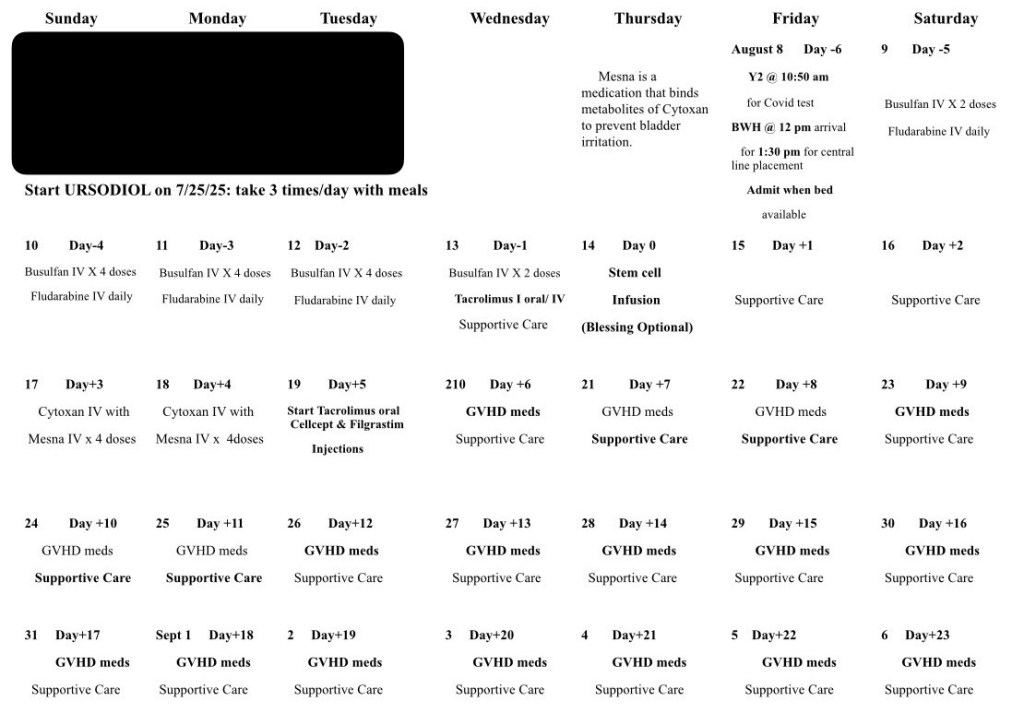
Above is the calendar I received from Dana-Farber outlining the specific dates, drugs, and a few other fun details. I’ll dive deeper into the cocktail of medications they use throughout this entire process in a future post. They’ve already explained the purpose behind each one that they plan on using, but I want to fully understand and experience them myself before attempting to relay that information to you all.
More than anything, I want to share data from my actual experience and not just an opinion on what I think will happen or what the doctors say clinically should happen. I hope that makes sense.

I’m sharing the calendar partly because I plan to start the “Field Notes” section of this blog soon after my admission. The idea is to update you once a week or so with how the previous Monday through Sunday went. Will I be able to stick to weekly updates? Maybe, maybe not. We’ll see. But for now, that’s the goal.
Those posts will likely be more to the point than these long-form posts. I’ll share updates on how I’m feeling physically and mentally, what I’m eating, whether I’m exercising, the check-ins I’m having, basically anything and everything related to the day-to-day experience of my transplant.
Closing Thoughts
Up to this point, I’ve tried my best to lay the groundwork for what is happening with my specific situation as well as share some resources and tips that I have found useful during the pre-transplant phase. I hope I have accomplished that goal.

When this post goes live, I’ll be just nine days away from my admission. While I’ve covered pretty much everything I could think of for this phase, there’s one last topic I want to touch on. Why I decided to do all of this in Boston.
The city has always meant a lot to my family and I, and I’m looking forward to sharing the reasons why with you all. At the very least, I hope it provides a welcome break from the last few detail-heavy pre-transplant prep posts.
As always, I’d love to hear from you all. Feel free to reach out with any questions or thoughts.
Talk Soon,
– Ethan
Resources
Misc. links directly referenced in this article:
- Preparing the Home
- Merach Exercise Bike
Leave/Disability specific resources:
- FMLA Frequently Asked Questions
- Paid Leave Laws by State
- Navigating Disability/Benefits
Caregiver specific resources:
- Dana-Farber Caregiver Resources
- National Marrow Donor Program (NMDP) Caregiver Resources
- Role of Caregiver(s)
- FMLA for Caregivers
Housing specific resources:
- American Cancer Society Hope Lodge Locations
- https://www.cancer.org/support-programs-and-services/patient-lodging/hope-lodge.html
- American Cancer Society Hope Lodge – Boston
- https://www.cancer.org/support-programs-and-services/patient-lodging/hope-lodge/boston.html
- Dana-Farber Lodging
- https://www.dana-farber.org/patient-family/planning-your-visit/lodging
Financial/Insurance specific resources:
- Dana-Farber Financial Resources
- NMPD Financial Resources
- BMT Info Financial Resources


 Long Way From Home
Leave a reply to Debbie Cancel reply